
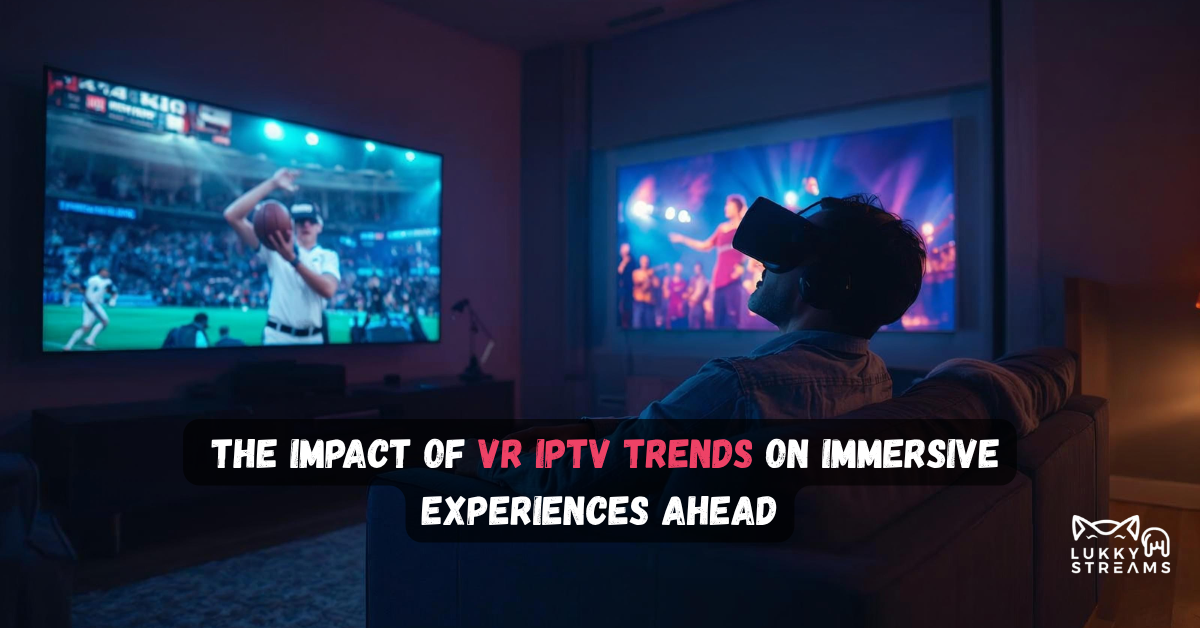
Virtual Reality (VR) is poised to revolutionize Internet Protocol Television (IPTV) by creating deeply immersive, personalized viewing experiences. Industry forecasts suggest that by 2025, the global IPTV market will top $189 billion and the VR market will surge (forecast to reach ~$123 billion by 2032). These intersecting growth trajectories underscore why VR IPTV trends are now a hot topic. By blending VR headsets (like Meta Quest and Apple Vision Pro) with IPTV streams, viewers will “step inside” their content – from sports arenas to virtual living rooms. This blog explores those trends, highlighting how personalization in VR IPTV is reshaping entertainment, and how providers (such as Lukkystreams) can scale globally to support these innovations.
The Core of VR IPTV: Hyper-Personalization
The essence of the VR IPTV trends lies in turning passive TV watching into an active, customizable journey. Rather than simply selecting channels, viewers might design their virtual environments – choosing a digital couch by a virtual fireplace or virtually “transporting” themselves courtside at a game. Advanced AI and machine learning are a core part of this shift. AI/ML is now “foundational” for IPTV, enabling hyper-personalized recommendations and adaptive streaming.
In a VR context, that means the system could tailor not only the content (what you watch) but the experience (how you watch). For example, an IPTV app might automatically adjust VR scenery and detail based on the user’s preferences or context (time of day, mood, etc.), while recommending the next VR movie or VR sports channel. Crucially, robust streaming infrastructure backs these features.
Lukkystreams, for instance, touts 99.9% uptime and broadcast-grade streams via multiple global data centers, ensuring that high-bandwidth VR streams arrive without buffering. In summary, VR IPTV trends are about personalization on steroids – AI-driven content plus fully immersive VR environments.
Stepping Inside the Content: Immersive Environments
Many VR IPTV trends center on creating immersive environments. VR headsets fully surround users with digital worlds. In practice, this means IPTV could deliver 360° videos and interactive media that put the viewer “inside” the action. For example, a VR-enabled IPTV sports channel might show a football game via a spherical camera rig; viewers wearing a headset can look anywhere on the field as play unfolds.
Services will offer “360-degree content” and let users move freely in virtual spaces. Similarly, live concerts or events can be beamed into your headset, letting you look around backstage or even join virtual crowds. These immersive experiences go beyond flat-screen TV – they turn watching into presence. Such VR/AR innovations will transform IPTV from “content consumption” into shared, interactive experiences. In essence, VR IPTV trends promise to make viewers feel like they are really at the venue or inside the scene, not just watching it.
Revolutionizing Sports and Live Events
On the sports front – a key driver of these trends – VR could totally redefine game viewing. By 2025, future VR IPTV for sports might let fans enjoy matches with front-row realism. Imagine settling into a virtual stadium seat or even sitting on the sideline: VR cameras placed around a pitch can stream every angle. In VR, you could choose your viewpoint – watch from behind the goalkeeper, above midfield, or via a referee’s perspective. As one report notes, “VR could allow viewers to experience live events from 360 degrees”, and AR can overlay live player stats in real time.
These ideas are already being tested: technologies like VAR in football hint at VR’s capability for immersive field views. For example, a user with a VR headset and controllers might sit in a virtual suite, watching a giant screen while immersed in 3D surrounds. “Immersive 360-degree live sports events” will redefine engagement. Other sports – basketball, motorsports, tennis – could follow, offering a VR “on-site” experience. Broadcasting companies are exploring these trends; the goal is that by mid-decade, VR IPTV for sports will allow families or friends to join virtual viewing parties on the field or court, complete with shared social features.
Beyond Sports: Entertainment and Social Viewing
Outside sports, entertainment and culture are also riding the VR IPTV trends wave. Virtual reality concerts and cinemas are on the rise. Major platforms like Netflix, Disney+ and HBO have experimented with VR theaters. Users can put on a headset and sit in a virtual living room or outdoor amphitheater, then enjoy movies or shows on giant virtual screens. Some creators are pushing interactive storytelling in VR – where the story unfolds around the viewer rather than on a flat screen. Similarly, VR music festivals (as done by Ariana Grande, Travis Scott, and others) have shown there’s appetite for virtual live shows. IPTV services can integrate these by offering VR concert channels and on-demand VR playlists.
Other trends include social VR viewing: viewers gather as avatars in a virtual space to watch programming together, chat in real time, and react with virtual gestures. This makes TV a shared experience even when people are miles apart. In all these ways – sports, concerts, cinema, and social – VR adds a spatial, interactive dimension that flat IPTV cannot provide.
Key Examples of VR IPTV Content:
- 360° Sports Broadcasts: Live sports streamed with VR cameras let fans look around the field and choose their own angle. Players’ stats can appear as overlays in the virtual view.
- Virtual Cinemas & Concerts: Movies and live music events played in a VR theater or venue. Users can experience concerts on stage or explore VR movie worlds.
- Social VR Watch Parties: Friends’ avatars gather in a virtual space (living room, stadium suite, etc.) to watch IPTV channels together. This blends social media interactivity with viewing.
- Interactive VR Overlays: Viewers might interact with content (e.g. select alternate camera feeds, join polls, “poke” fellow viewers) or even virtually try products from ads.
The Technology Powering the VR IPTV Revolution
Behind these experiences are technology drivers that make them possible. The rollout of 5G networks is a big one. 5G offers multi-gigabit speeds and ultra-low latency, which “unlocks streaming 4K and even 8K content with unparalleled fluidity”. For VR IPTV, this means less lag and buffering even for very high-resolution 360° video. On top of raw connectivity, AI and ML are essential for personalization. AI-powered recommendation engines (already common on Netflix) will soon suggest entire VR environments and interactive experiences based on your interests.
Moreover, IPTV’s evolution depends on this trio: 5G, AI, and immersive VR. Streaming infrastructure must adapt as well – Lukkystreams and other providers use cloud-CDNs and edge servers to deliver streams globally with minimal delay. They also employ adaptive bitrate streaming (often aided by AI) to ensure smooth VR playback under varying network conditions. These tech foundations – fast networks, smart algorithms, powerful headsets – collectively enable the next-gen VR IPTV trends.
The Global Landscape and Future Outlook
Globally, the move toward VR-enhanced IPTV is accelerating. Regions with strong 5G and high device adoption (North America, Europe, parts of Asia) are already exploring VR offerings. In emerging markets, cheaper VR headsets and expanding mobile networks will bring VR IPTV to more users. Industry analysts project that immersive technologies will reach mass markets by 2025. In the coming months, IPTV platforms will likely launch trial VR channels and “second-screen” VR features.
For example, one can imagine during a live sports game switching from traditional TV to a VR view seamlessly. The “metaverse” trend is also fueling interest: as companies build virtual social spaces, integrating live IPTV content (sports games, news, concerts) into those spaces is a natural step. All of these trends underscore a shift: TV viewing is no longer confined to the living room.
What This Means for IPTV Resellers and Streamers
For IPTV resellers and streamers, keeping pace with VR IPTV trends is crucial. Services like Lukkystreams are positioning themselves to help partners scale in this new era. As Lukkystreams notes, its unified platform delivers high-quality, broadcast-grade streams across Europe, North America, and the Middle East. This global reach means resellers can add VR channels without worrying about regional bandwidth or reliability issues.
In fact, Lukkystreams boasts five global data centers and 99.9% uptime, ensuring that even bandwidth-heavy VR streams run smoothly. Their turnkey solution handles source acquisition, transcoding, and distribution so clients can focus on content and customization. In practical terms, an IPTV business could work with Lukkystreams to launch a new VR sports channel: Lukkystreams would manage the technical pipeline, while the reseller creates compelling VR content and markets it. This model is scalable globally, aligning with the demand for VR IPTV around the world. As Lukkystreams puts it, IPTV partners can “focus on growth” while they handle the tech and monitoring.
Key Strategic Trends to Watch
Looking ahead, several VR IPTV trends should shape strategy:
- Device Innovation: Upcoming VR headsets (lighter, higher-res, wireless) will boost adoption. Think Meta Quest 3, Apple Vision Pro and successors, all enabling better IPTV experiences. Content must be ready.
- Content Experimentation: IPTV providers will pilot new VR genres – interactive shows, VR news studios, even VR shopping channels. The next big hit could be a VR game show or a virtual travel program.
- Standardization and UX: User interfaces will evolve for VR IPTV – menus and guides in 3D space, gesture/voice controls, and seamless switching between 2D and VR modes. Personalization features (profiles, VR avatars) will improve.
- Regulatory and Rights Issues: As VR channels emerge, securing rights to broadcast in VR (especially live sports) will become important. Resellers should work with providers (like Lukkystreams) who are on top of licensing and compliance.
Conclusion: The Future is Immersive
In conclusion, VR IPTV trends are ushering in a new era of personalized, immersive entertainment. By combining cutting-edge VR technology with the flexibility of IPTV, viewers will soon enjoy experiences that are customized, interactive, and far beyond traditional TV. Sports fans will feel like they’re on the field, concert-goers will be front-row from home, and every viewer will have a say in how and where they watch.
For IPTV entrepreneurs and resellers, embracing these trends means investing in VR-ready infrastructure and partnerships. Lukkystreams, with its global, scalable streaming platform, stands ready to support the VR revolution in IPTV. We encourage readers – whether industry professionals or curious enthusiasts – to stay tuned. These VR IPTV trends are evolving rapidly, and those who adapt now will lead the charge into the fully immersive, personalized viewing experiences of the near future.
Ready to future-proof your IPTV service and lead the charge in immersive entertainment? Call us today to discover how our broadcast-grade, globally scalable platform can help you launch and deliver stunning VR IPTV experiences to your audience.